There is a particular kind of praise that means more than a five-star review or a trending hashtag. It is the kind that comes quietly, from people who have worked closely with someone over years - and who, when they finally speak, sound less like they are promoting a project and more like they are settling a debt of gratitude.
That is the kind of praise Arunabh Kumar has been receiving lately.
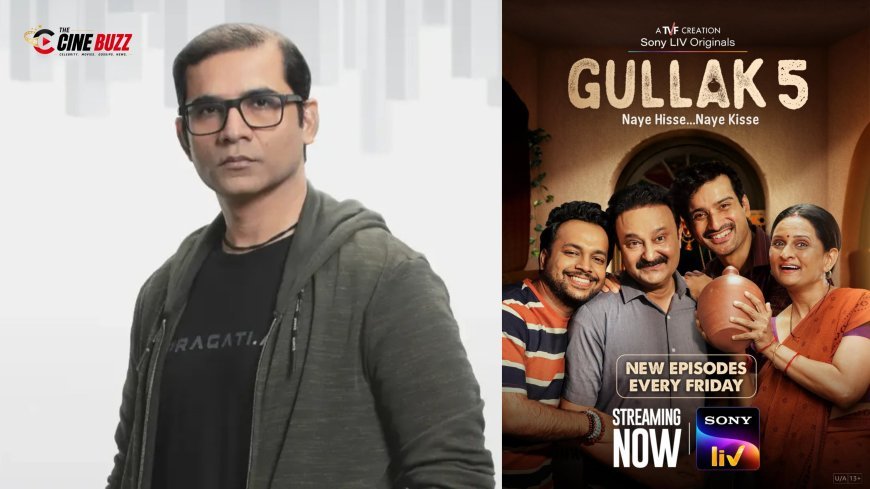
As Gullak returns for yet another season - and once again finds itself embedded in the emotional vocabulary of middle-class India - two of its lead actors have stepped forward to say something that the ratings charts cannot capture. Sunita Rajwar and Jameel Khan, both central to the show's quiet magic, have spoken about the man who built The Viral Fever from a scrappy YouTube experiment into one of the most respected names in Indian streaming. And what they have said is telling.
The Man Who Started It All
Before the IMDb rankings, before the OTT dominance, before Panchayat became a cultural institution and Gullak made an entire generation feel seen - there was a young engineer from IIT Kharagpur with a camera, an idea, and a stubborn belief that Indian audiences deserved better stories than they were being offered.
Arunabh Kumar founded The Viral Fever in 2010, at a time when YouTube in India was still largely a platform for music videos and film clips. He was twenty-three years old. The concept was deceptively simple: make content that reflected real Indian life - not the glamourised, aspirational version sold by Bollywood, but the version that smelled like home cooking and sounded like family arguments over the dinner table.
The early videos were rough around the edges. The budgets were almost nonexistent. But they found an audience, because they were honest in a way that mainstream Indian entertainment rarely allowed itself to be.
Kumar grew up in Patna, Bihar - a background that would later prove integral to TVF's creative identity. The small-town, middle-class sensibility that runs through shows like Gullak and Panchayat is not manufactured for relatability. It comes from somewhere real.
Building TVF: From YouTube Channel to Content Powerhouse
What Kumar built over the next decade and a half was not just a production house. It was, in a real sense, a new grammar for Indian storytelling on screen.
TVF's early breakout came with Permanent Roommates in 2014 - widely regarded as one of India's first successful original web series. The show was modest in production but bold in subject matter, addressing live-in relationships and urban romance with a frankness that Indian television had never attempted. It found an immediate audience among young, urban viewers who had grown up consuming Western content and were hungry for something that spoke their language without mimicking it.
From there, TVF moved methodically - not always quickly, but always with a clear sense of what it was and was not willing to make. Pitchers, which followed four friends leaving their jobs to start a company, arrived in 2015 and became a touchstone for an entire generation of Indian entrepreneurs and dreamers. Kota Factory, shot in striking black and white, confronted the psychological cost of India's engineering entrance exam culture with a seriousness the subject had never previously received.
Each show expanded TVF's universe while staying anchored to the same set of values: character over plot, observation over spectacle, emotional truth over dramatic convenience.

A Career Revived, A Confidence Restored
Sunita Rajwar did not mince words. She said TVF, and Arunabh Kumar specifically, changed her life.
That is not a small thing to say in an industry where actors routinely spend years doing credible work without ever quite breaking through. Rajwar had done exactly that - decades of solid performances, a recognisable face, but never quite the cultural moment that shifts a career. Gullak gave her that moment. More than the recognition, she said, it gave her something harder to quantify: confidence, at a point in her professional life when it had begun to feel like a finite resource.
What struck her, she noted, was not just the opportunity - it was how Kumar carried himself through TVF's success. As the production house grew from cult favourite to mainstream phenomenon, as its shows started appearing on global rating lists and its name became shorthand for quality Indian storytelling, Kumar remained, by her account, the same person she had met at the beginning.
A Promise Made, A Promise Kept
Jameel Khan's account is more specific, and in some ways more striking.
He recalled a conversation with Kumar after one of Gullak's early seasons - a moment when the show had already begun to find its audience, when it was clear that something genuine had been created. Khan told Kumar plainly: they had made something special, and he wanted to know it would be protected. He did not want the pressures of success - the demand for more seasons, more reach, more revenue - to sand down what made the show worth watching in the first place.
Kumar told him the soul of Gullak would not be compromised.
Khan says it has not been. Season after season, in a medium where sequels routinely hollow out what made the original work, Gullak has held its shape. The humour is still grounded in recognition rather than exaggeration. The emotion still earns itself. The Mishra family still feels like a family, not a brand.
The Numbers, For Those Who Need Them
For those who prefer their cultural arguments quantified, TVF's IMDb presence makes the case bluntly.
Multiple TVF productions sit on the platform's Top 250 TV Shows list - Panchayat, Gullak, Kota Factory, Aspirants, Pitchers and Yeh Meri Family among them. For a single production house, from any country, that kind of representation is remarkable. For an Indian digital studio that did not exist fifteen years ago, it is extraordinary.
The Consistency Problem, Solved Differently
What makes TVF's track record genuinely unusual is not any single show. It is the pattern.
Panchayat. Kota Factory. Aspirants. Yeh Meri Family. Pitchers. Each of these shows is distinct in setting, tone and subject matter. Each has found a dedicated audience. And each carries the same underlying quality - a seriousness about character, a resistance to cheap resolution, an emotional honesty that Indian television had largely abandoned long before streaming arrived to offer an alternative.
What Comes Next
TVF is not standing still. The production house has announced its first feature film ventures - Vvan and College Fest - alongside new series and returning seasons of existing franchises. The move into film is a natural expansion for a studio whose storytelling sensibility has always been cinematic in ambition, if modest in scale.
Whether the transition works remains to be seen. Films are a different discipline, with different pressures and different audiences. TVF's identity has been built on the particular intimacy of serialised storytelling - the slow accumulation of character detail that only multiple episodes across multiple seasons can provide. A film asks for something more compressed, more immediate.
But then, TVF has navigated transitions before. From YouTube to OTT. From niche to mainstream. From one beloved show to half a dozen.